QUICK ANSWER
Spider mites show up as fine, pale stippling on leaves, fine webbing when populations get heavy, and tiny moving specks visible on the underside of leaves or a white sheet of paper held beneath them. They thrive specifically in hot, dry conditions, which is exactly why outbreaks tend to spike during summer heat waves. Rinsing plants with a strong water spray and encouraging natural predators handles most home garden cases without needing a pesticide at all.
Identifying Spider Mites
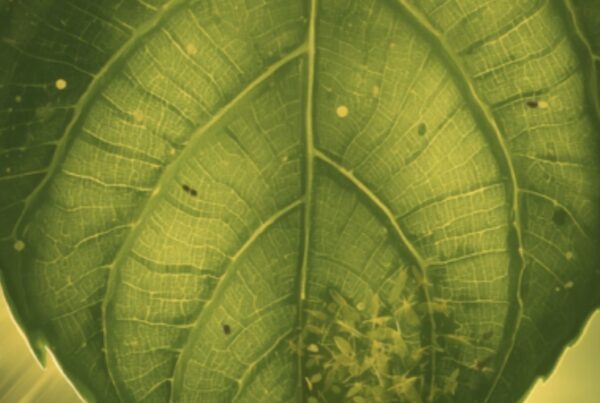
Despite the name, spider mites aren’t insects at all — they’re tiny arachnids, related to spiders and ticks, and the most common species affecting vegetable gardens (the two-spotted spider mite) is barely visible to the naked eye at about 1/50th of an inch long. They feed by puncturing leaf tissue and sucking out chlorophyll, which is what produces the telltale fine, pale stippling you’ll see on the upper leaf surface, even though the mites themselves are feeding on the underside.
As populations build, they spin fine webbing across leaves and between stems — the feature that gives spider mites their name. At that point, an infestation is usually well established, since webbing shows up later than the initial stippling damage. Beans, tomatoes, and cucurbits (cucumber, squash, melon) are among the most commonly affected vegetables, though spider mites can turn up on a wide range of other plants too.
Why Spider Mites Thrive in Certain Conditions
Hot, dry weather is spider mites’ favorite environment — populations can build shockingly fast during a summer heat wave, sometimes completing a full life cycle in as little as eight days under warm conditions. This is part of why outbreaks often seem to appear suddenly: conditions that barely register as a heat wave to you can be exactly what a small, unnoticed mite population needed to explode into a visible infestation within a week or two.
Plant stress is a major contributing factor too, and it cuts in multiple directions. Both overwatering and underwatering can make plants more susceptible, and the same is true of over- or under-fertilizing — a plant that’s already struggling has less capacity to resist mite pressure than a healthy one. This is worth keeping in mind if you’re also dealing with a watering or nutrient issue at the same time as a mite problem, since fixing the underlying stress can make a real difference in how quickly the mites get out of hand.
How to Treat Spider Mites
• Rinse plants thoroughly with a strong water spray, focusing on leaf undersides — this physically dislodges mites and disrupts their webbing, and it’s often enough to handle a mild, early infestation on its own.
• Raise humidity where practical. Spider mites specifically favor dry conditions, so misting or grouping plants together to raise local humidity works against them directly.
• Use insecticidal soap if rinsing alone isn’t enough, applying thoroughly to leaf undersides where mites actually live and feed.
• Avoid broad-spectrum pesticides when possible. They kill off the predatory mites and beneficial insects that naturally keep spider mite populations in check, which can actually make future outbreaks worse rather than better.
• Rotate treatments if repeat applications are needed. Spider mites build resistance quickly when the same product is used over and over, so switching between different active ingredients helps keep any single treatment effective longer.
Maintaining a diverse garden with a mix of perennials and flowering plants nearby genuinely helps too, since it supports the natural predators — predatory mites, ladybugs, and lacewings among them — that keep spider mite populations in check without any intervention on your part. Gardens that rely heavily on broad-spectrum pesticides tend to see worse mite problems over time specifically because those treatments wipe out the predator population along with the pests, removing the natural check that would otherwise prevent an outbreak from building in the first place.
Related Questions
How can I confirm it's spider mites and not another pest?
Hold a white sheet of paper under affected leaves and tap the foliage gently — if tiny specks fall onto the paper and start moving, that confirms spider mites rather than a different pest or a nutrient issue.
Will spider mites go away on their own?
Cooler, wetter weather naturally slows them down significantly, and a hard winter frost typically kills off most outdoor populations — but during a warm, dry stretch, they generally need active intervention rather than waiting them out.
Can spider mites spread to my other plants?
Yes, readily — they can walk between touching plants and are also easily carried on wind, tools, or hands, so isolating a heavily infested plant is worth doing while you treat it.