QUICK ANSWER
Root rot signs and treatment both start with the same fact: this is a genuine infection, not just a watering mistake. Wilting despite moist soil, yellowing leaves, and a soft, mushy stem base with roots that are dark and slimy rather than firm and pale all point to root rot. Since it’s caused by fungus-like organisms that move into oxygen-starved roots, treatment means removing affected tissue and fixing drainage — more careful watering alone won’t undo damage that’s already underway.
Root Rot Signs and Treatment: Why This Is Different From Overwatering
It’s worth being precise about something here: overwatering itself doesn’t directly cause root rot — it creates the conditions that let it happen. When soil stays saturated, the air pockets roots need for oxygen fill with water, and roots deprived of oxygen for roughly 48 to 72 hours begin to weaken and die. That’s the opening opportunistic fungus-like organisms — commonly Pythium and Phytophthora, along with true fungi like Rhizoctonia and Fusarium — are waiting for. Root rot is a genuine infection layered on top of an oxygen problem, not simply “too much water” on its own.
Plant disease specialists sometimes describe this using a “disease triangle” — a pathogen (usually already present in garden soil), a susceptible host (a plant weakened by prolonged saturation), and the right conditions (sustained wet soil) all have to line up together. Remove any one leg of that triangle and root rot doesn’t take hold, which is exactly why fixing drainage matters as much as adjusting how you water.
Confirming Root Rot Signs Before Treatment
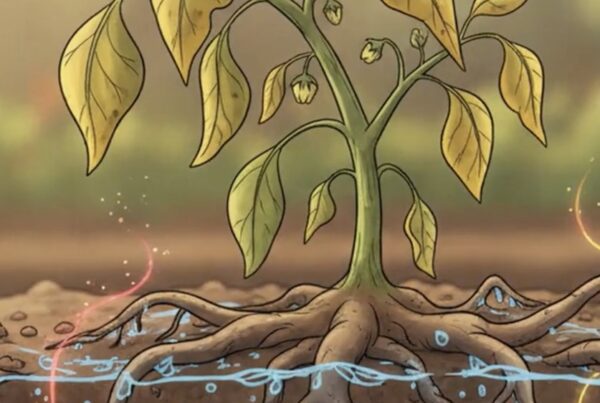
The only way to confirm root rot with certainty is to actually look at the roots. Gently remove the plant from its pot or loosen soil around the base, and compare what you see to healthy roots, which should be firm, pliable, and pale white or tan. Roots affected by rot will be dark brown to black, soft, and mushy, sometimes accompanied by a distinct sour or swampy odor. Above ground, expect yellowing leaves (often several at once rather than just the oldest one), wilting despite damp soil, stalled growth, and a soft or blackened area right at the stem base.
Root Rot Treatment That Actually Works
• Remove the plant and trim away all affected roots with clean, sterilized scissors or shears — cut back to firm, healthy tissue, since any rotted root left in place can continue spreading the infection.
• Repot into fresh, well-draining soil, never the original soil the plant came out of, since that soil likely still harbors the pathogens responsible for the rot in the first place.
• Fix the underlying drainage problem, not just the watering schedule. A pot without real drainage holes, or a bed with heavy, slow-draining soil, will keep creating the same saturated conditions no matter how carefully you water afterward.
• Water less frequently and check soil moisture directly going forward, letting the top few inches dry out between waterings rather than keeping soil consistently damp.
• Accept that severely affected plants may not recover. If most of the root system is already dark and mushy by the time you catch it, the plant may be too far gone to save — starting fresh is sometimes the more realistic outcome.
Prevention is genuinely more reliable than treatment here, since by the time root rot signs show up above ground, real damage has often already happened below the surface. Checking soil moisture directly before watering, rather than sticking to a fixed schedule, avoids the sustained saturation that root rot pathogens need to establish. For plants or beds with a recurring history of root rot, improving soil structure with compost or coarse organic matter addresses the underlying drainage issue more permanently than adjusting watering habits alone ever could.
Related Questions
How is this different from damping off in seedlings?
Damping off affects young seedlings specifically, causing a sudden collapse right at the soil line — root rot can affect plants of any age and develops more gradually, with the roots decaying before symptoms show above ground.
Can I reuse the pot after removing a root-rotted plant?
Clean it thoroughly with a diluted bleach solution first — the pathogens responsible for root rot can persist in residue left on pot surfaces, potentially affecting whatever you plant there next.
Is hydrogen peroxide a real treatment for root rot?
It can play a minor supporting role, but it isn’t a standalone fix — peroxide breaks down within minutes and can’t reach pathogens deep in a saturated root ball, so it only helps as one step alongside actually cutting away dead roots and fixing drainage.
Related: Overwatering signs and how to fix them · Fixing poor drainage
Sourced from: University of Georgia Cooperative Extension