QUICK ANSWER
Why vegetables bolt comes down to three triggers: heat, lengthening days, and early cold, with crowding and overgrown transplants making each one worse. Lettuce, spinach, and cilantro bolt as the weather warms and days lengthen, onions bolt after weeks below 50°F, and broccoli, cauliflower, and cabbage bolt when they go out too early into a cold spring. Once a flower stalk forms the harvest is mostly over, so the fix is timing: plant in the cool part of the season, choose slow-bolting varieties, and pick before the stalk appears.
Why Vegetables Bolt: What Is Happening Inside the Plant
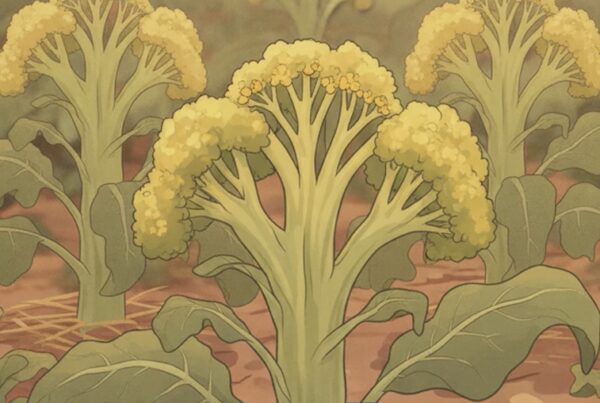
Bolting is the term gardeners use for flower stalk formation, or premature flowering that can begin at any point after a plant has shifted from growing into its reproductive stage. The plant stops building leaves, roots, or tight heads and starts building a stalk, flowers, and seed. That is why a bolted lettuce sends up a tall center stem and why a broccoli head opens into yellow flowers (see our broccoli turning yellow guide).
Many of the vegetables that bolt are biennials, plants that would normally take two years to finish their life cycle. They can form flower stalks early in response to cool or hot temperatures and long days. In other words, bolting is part of the plant’s life cycle running ahead of schedule, not a disease, which is why no spray or fertilizer corrects it.
The cost to you is the harvest. Bolting often prevents a usable crop, and spinach and lettuce turn especially bitter after they flower.
The Three Triggers: Heat, Long Days, and Early Cold
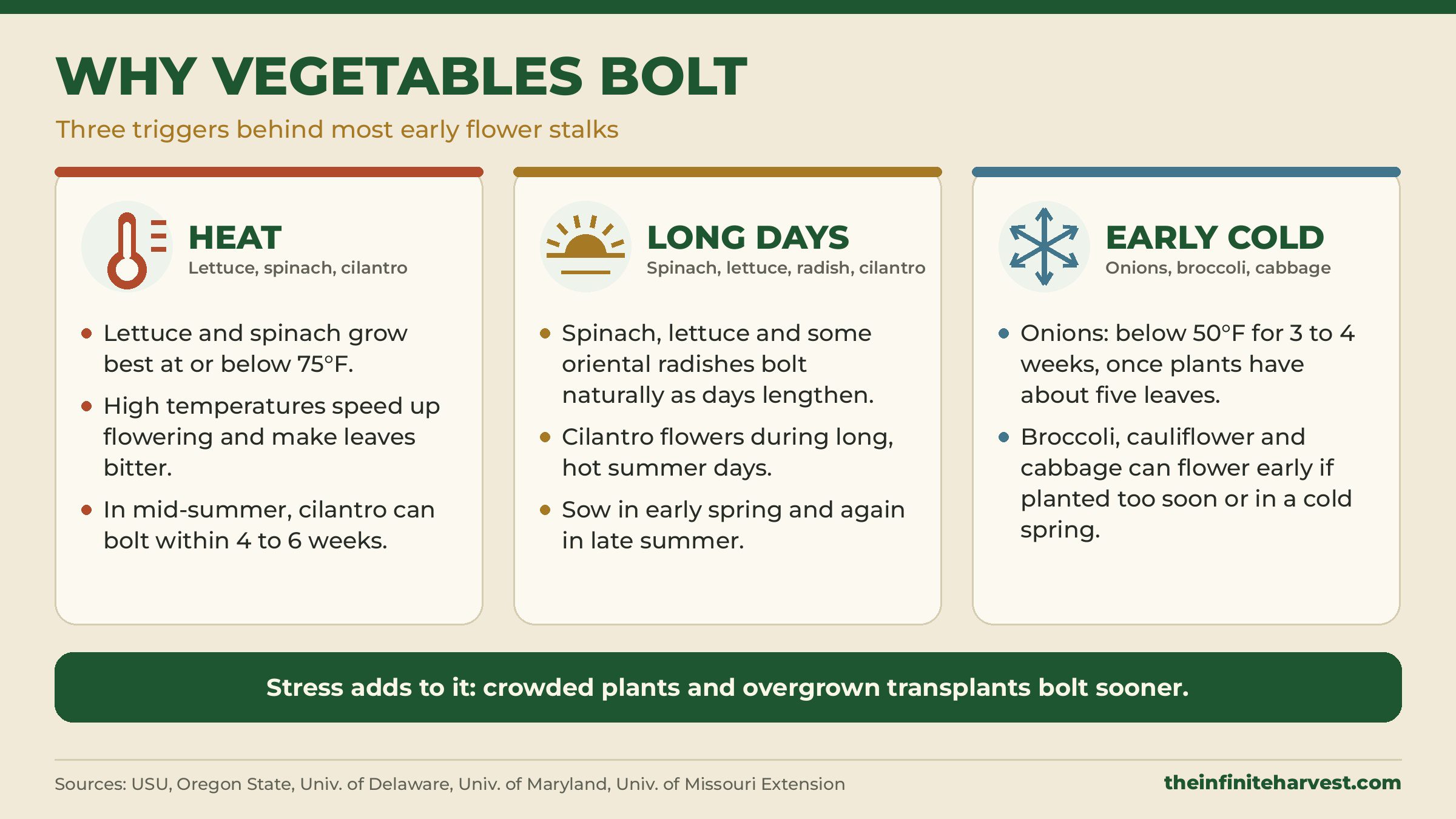
Bolting can be driven by temperature, day length, or both. Three triggers cover most of what happens in a home garden.
• Heat. Spinach and lettuce grow best when temperatures stay at or below 75°F, and high summer temperatures reduce growth and quality and push spinach to flower. Heat stress alone can set lettuce off. Cilantro is faster still: it typically bolts within four to six weeks in mid-summer heat.
• Long days. Spinach, lettuce, and some oriental radishes bolt naturally as days lengthen. The research is not unanimous: one extension answer, citing a Penn State Master Gardener, argues that shortening nights rather than heat is the main trigger for lettuce and spinach, and that heat only looks guilty because days lengthen as the weather warms. Either way, a late sowing runs into the longest days of the year.
• Early cold. Seedlings exposed to cold early in the season can be pushed toward flowering later, a process called vernalization. Onions show it clearly: seed stalks can form before the bulb matures when plants spend 3 to 4 weeks below 50°F, the effect is cumulative, and a plant needs about five leaves before it can register the cold at all.
• Stress on top. Overly mature or stressed transplants and close spacing give plants extra reasons to flower early.
Which Vegetables Bolt, and What Sets Each One Off
• Lettuce and spinach. Both respond to heat and lengthening days, so the goal is to finish them before summer arrives. For fall crops, choose early-maturing cultivars and plant 50 to 75 days before the date you expect them to mature. For late spring plantings of spinach, pick long-standing, slow-bolting types.
• Cilantro. Temperature and day length both drive flowering. A planting made in late June or early July flowers during the hottest, longest days, while cooler, shorter days in spring and fall let the plant make leaves for weeks or months. Its long taproot makes transplanting difficult, so sow it in place.
• Onions. Day length does not trigger onion bolting, although bulbing itself needs long days of 12 to 16 hours depending on the type. In a cool year, sets and transplants were the plants that bolted most.
• Broccoli, cauliflower, cabbage, kale, and collards. These flower prematurely when planted too early or when spring turns abnormally cold, and a transplant must reach a certain age before it becomes susceptible. Overwintered mustards, turnips, kale, and collards are fully chilled by spring and bolt then, so harvest them before the flower stalks rise. If your broccoli head is already turning yellow, start with our broccoli guide.
• Carrots and beets. These bolt less often. Beets, carrots, and onions can flower once they pass the juvenile stage, but it is uncommon.
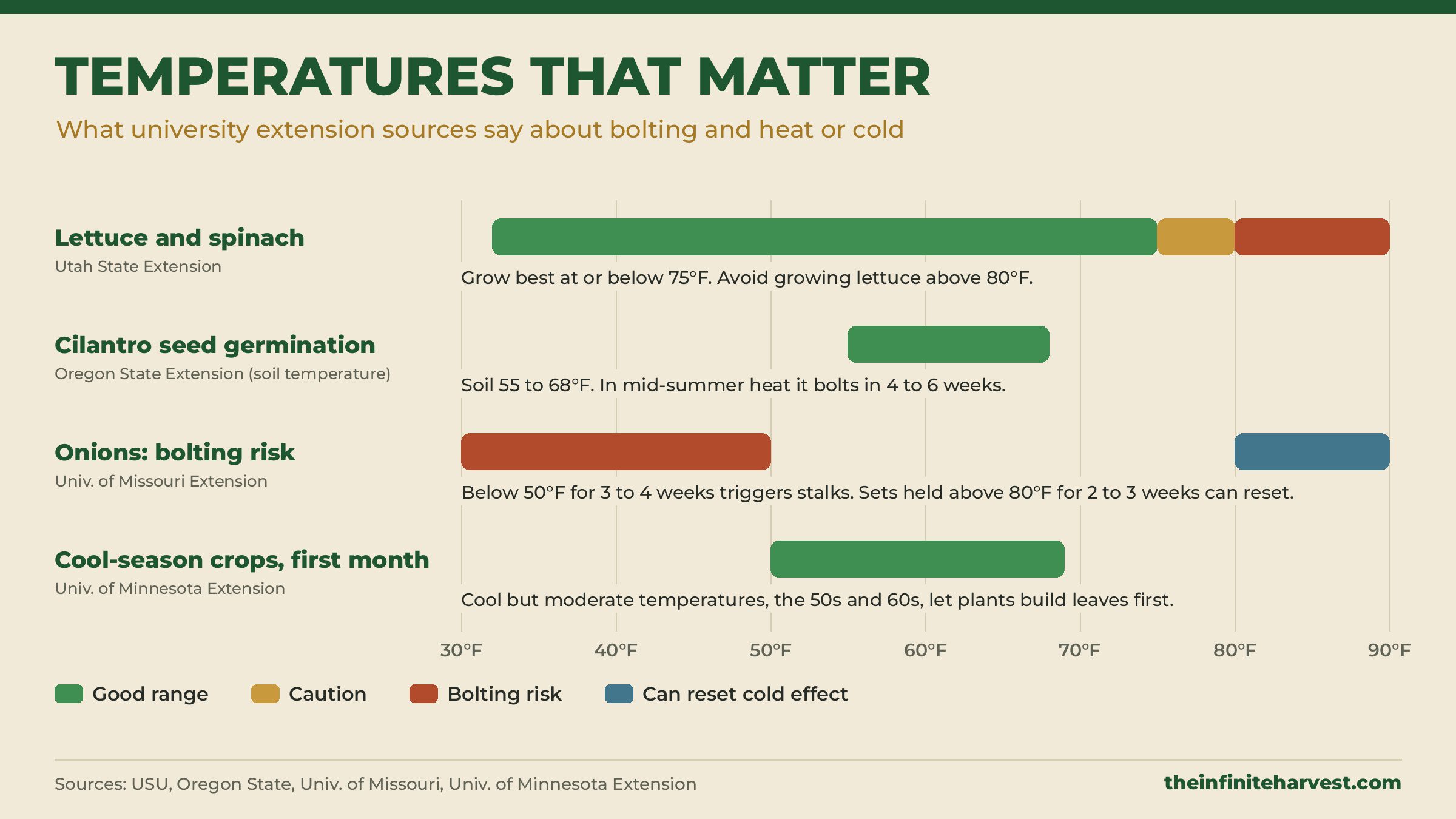
The chart below collects the temperature numbers from the sources listed at the end in one place.
How to Stop Vegetables From Bolting
Once a plant starts flowering there is little way back, but you can steer around the triggers.
• Plant inside the recommended window. Early planting contributes to bolting in crops such as cabbage, while late planting contributes in others such as lettuce. Start with your growing zone using our zone finder, then check local frost dates.
• Use transplants for brassicas, but not overgrown ones. Transplants start from seed that has not been chilled, so they are less prone to bolting. Transplanting beats direct seeding, but do not start seedlings indoors too early, and avoid buying or planting stressed, overly mature transplants.
• Pick slow-bolting varieties. Heat-tolerant or bolt-resistant varieties help, especially for later spring plantings. Slow-bolting spinach and lettuce exist, as do spring-adapted types of other crops.
• Stagger your sowings. Succession planting spreads the risk, and for cilantro a new batch every 2 to 3 weeks works well. Avoid sowing cilantro at peak summer heat, when plants bolt before producing many leaves.
• Shield young plants from cold snaps. Row covers or low tunnels reduce cold exposure. High tunnels allow earlier planting, but a cold snap can still trigger flowering.
• Keep plants cooler and evenly watered. Regular watering and an organic mulch such as straw reduce heat stress. For leaf harvests in warm weather, grow cilantro in a cool or semi-shaded spot.
• Give plants room. Close spacing encourages flowering.
• Lean on fall. Fall broccoli and cauliflower give more consistent yields than spring crops, and for a fall crop in central Maryland, sowing in late July works. Adjust the date for your own climate.
What to Do When Your Vegetables Start to Bolt
Act on the first sign of a flower stalk, because what you do next depends on the crop.
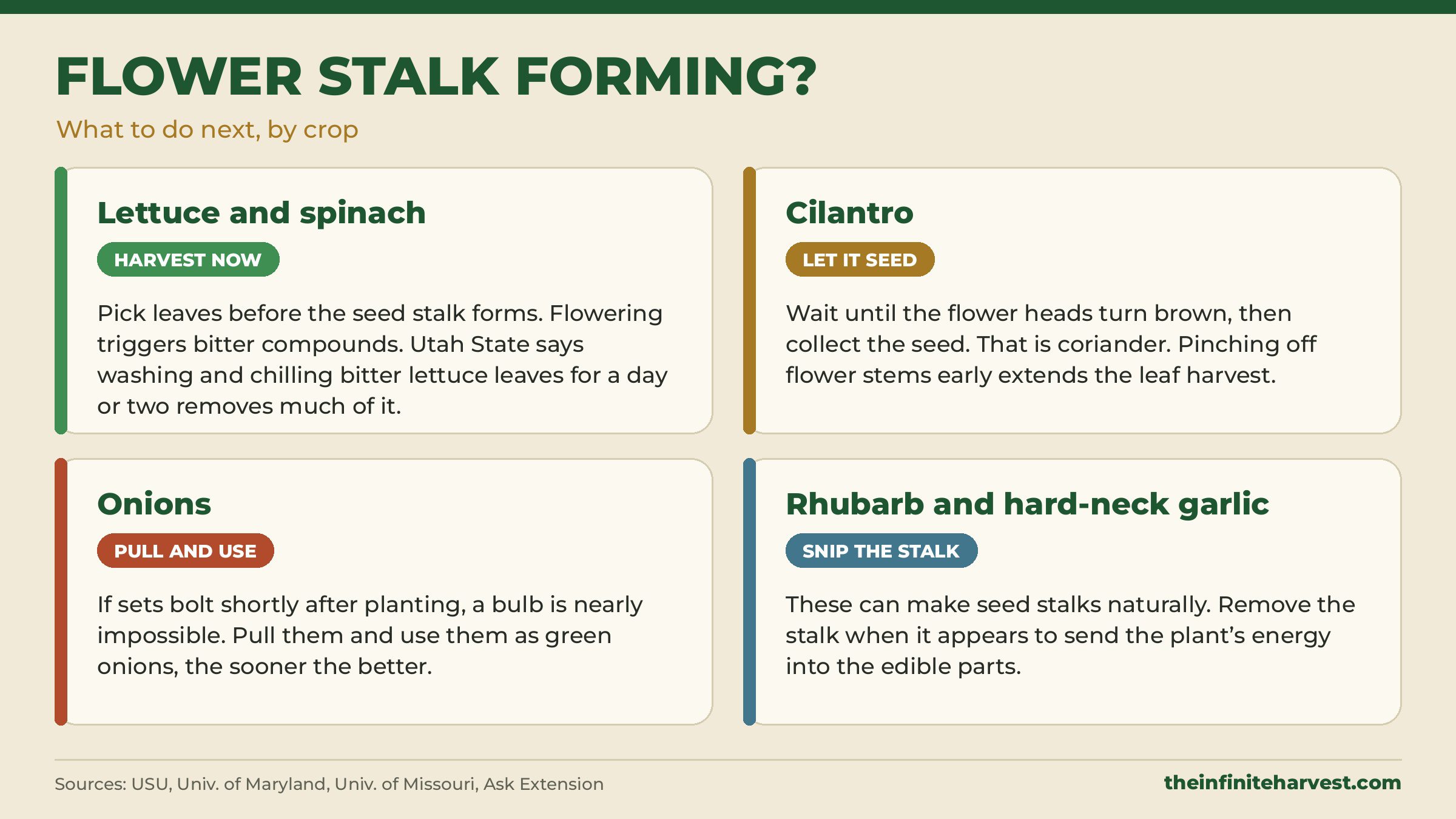
• Lettuce and spinach: harvest now. Leaf lettuce and spinach can be picked any time before the seed stalk forms, taking the older outer leaves first. Flowering brings on bitter-tasting compounds, but washing and refrigerating bitter lettuce leaves for a day or two removes much of the bitterness.
• Cilantro: let it finish if you want seed. Wait until the flower heads turn brown and then gather the seed, which is coriander. Pinching off flower stems early extends the leaf harvest, and the blossoms attract beneficial insects.
• Onions: pull sets that bolt soon after planting. A bulb is nearly impossible in that case, so use them as green onions, the sooner the better. Removing the seed stalk may help bulb formation a little, but the effect is limited.
• Rhubarb and hard-neck garlic: snip the stalk. These crops can make seed stalks as part of normal growth, and removing the stalk when it appears redirects energy into the parts you eat.
Bolting or Something Else? Look-Alike Problems
Several problems get blamed on bolting. Buttoning in broccoli and cauliflower is one: a plant switches to reproduction before it has enough leaves and forms a small, misshapen head. Nutrient, water, insect, or disease stress can cause it too, especially when transplants are held too long indoors. Our cauliflower not forming a head guide covers that case.
Failure to form a head or root, usually from too much nitrogen, crowding, or water stress, is another look-alike, as is bitterness in spinach and lettuce, which heat, water stress, and plant age can cause even before a stalk appears. Fruiting crops follow a different pattern: tomatoes, peppers, and beans drop flowers in heat rather than bolt, and blossom drop from heat explains that one.
If you are not sure what you are looking at, run the symptoms through the Plant Problem Finder.
Related Questions
Can you eat vegetables after they bolt?
The extension sources behind this guide describe bolted lettuce and spinach as bitter and often not worth harvesting, and none of them flags a safety problem. Taste a leaf first. Washing and refrigerating bitter lettuce leaves for a day or two removes much of the bitterness.
Can you stop a plant from bolting once it starts?
Not reliably. For leafy crops, the advice is to harvest before the stalk forms. For onions, removing seed stalks may help bulb formation but the effect is limited, and once enough cold has accumulated, bolting cannot be avoided. For rhubarb and hard-neck garlic, snipping the stalk is the normal practice.
Does shade cloth stop bolting?
It can help with heat but not with day length. One extension answer notes that a Delaware source suggests 30 percent black cloth to keep temperatures down, while a Penn State Master Gardener points out that shade cloth does little to prevent bolting because it does not lengthen the night. Use it to cool plants, and still plan your sowing dates around the season.
Is bolting ever a good thing?
For cilantro, yes. The flowers develop into seed you can dry and grind as coriander, and the blossoms attract beneficial insects. For most other vegetables, it ends the harvest.
Sourced from University of Maryland Extension (flower stalks and bolting, natural seed stalks and cilantro), University of Delaware Extension (bolting in spring planted vegetables), University of Minnesota Extension (non-pest issues in cool-season crops), University of Missouri Integrated Pest Management (why onions bolt), Utah State University Extension (lettuce and spinach), Oregon State University Extension (cilantro), and Ask Extension (lettuce bolting answer).