QUICK ANSWER
Your vegetable garden in summer heat needs watering based on the root zone, not the surface — a garden can look watered on top while the roots below are already dry. Check moisture a few inches down, water slowly and deeply rather than in frequent shallow sprinkles, and do it in the early morning when possible. That combination keeps roots healthy through summer heat with far less guesswork than watering on a fixed schedule.
Your Vegetable Garden in Summer Heat: Why the Surface Lies to You
Heat increases evaporation from the soil, wind pulls moisture away even faster, and larger plants lose water through transpiration, releasing water vapor through their leaves. All three change from day to day, which is exactly why a fixed watering schedule stops working reliably once summer heat sets in. The fix isn’t a better schedule, it’s checking the actual root zone before deciding.
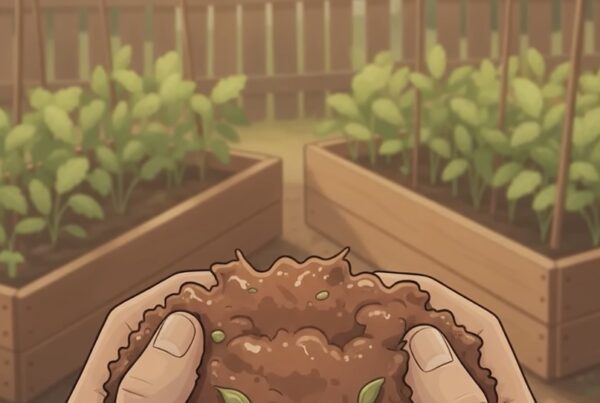
Push a finger a few inches into the soil near the plant, not directly against the stem. The top layer can feel dry while the root zone underneath is still moist, or the surface can look damp after a brief shower while the deeper soil stays dry. If it feels cool and slightly moist below the crust, wait. If it feels dry and loose, water thoroughly. A container that’s noticeably lighter than usual, or a moisture meter used as a supporting check rather than a final answer, can back up what your hand tells you. Watch what the water itself does, too: if it runs off the surface immediately rather than soaking in gradually, that’s its own clue the soil needs attention, whether that’s a slower application or a structural fix like loosening compacted ground.
Timing and Technique Matter More Than Frequency
Morning is usually best — cooler air, calmer wind, and leaves that get wet have time to dry before disease-favoring humidity sets in overnight. Evening watering can work when morning isn’t possible, but avoid routinely leaving foliage wet overnight.
Water slowly enough to soak the root zone, aimed at the soil rather than the leaves, instead of a quick stream that runs off or disappears down a crack. Frequent shallow sprinkles create a misleading improvement — the surface looks damp, leaves perk up briefly, then the plant struggles again as that thin layer dries. Worse, repeatedly wetting only the top layer trains roots to stay shallow, right where heat and evaporation are strongest. Deeper, less frequent watering encourages roots to explore more soil and builds a more stable supply between checks.
Your Soil Type Changes the Whole Rhythm
The same watering plan doesn’t work for every garden, and soil texture is the main reason why. University of Minnesota Extension frames it as roughly a two-to-one difference in practice: gardens on light, sandy ground typically need a session on the order of twice what a heavier, moisture-retentive bed needs over the same week. Sandy soil’s larger particles simply let water drain through before plant roots get much benefit from it, while clay’s fine particles hold onto water far longer, sometimes long enough to risk waterlogging if you water on the same schedule you’d use for sand.
In practice, that means matching your watering session to your actual soil, not a generic rule. Oregon State University Extension recommends smaller, more frequent applications for sandy soil since it can’t store a large volume at once, and fewer, deeper sessions for clay-heavy soil, which holds what it gets for much longer. Working compost or other organic matter into either soil type helps: it improves sandy soil’s ability to hold moisture longer between waterings, and improves clay soil’s drainage so it’s less prone to staying saturated.
Special Cases Worth Knowing
• Young transplants need closer attention even in moist beds — their root systems are still small and can dry out fast in hot wind, even when the surrounding soil is fine. As the plant grows and its roots spread outward, widen the area you’re actually watering to match, rather than continuing to water only the original small planting spot and creating a permanently soggy pocket right at the stem.
• Wilted bean leaves don’t always mean the bed needs water. Check the soil first — if it’s already moist, look for poor drainage, root damage, or heat stress instead of adding more water.
• Squash and other broad-leaved plants often wilt in peak afternoon heat even with adequate soil moisture, simply because big leaves lose water faster than roots can replace it in the moment. Check again once temperatures ease — if the plant recovers by evening and the root zone is moist, extra watering isn’t needed.
• Raised beds and containers dry faster than ground soil since they drain well and hold a smaller volume — check them more often, but more frequent checking doesn’t automatically mean more frequent watering.
Where Mulch Fits In
A layer of straw, shredded leaves, or finished compost slows evaporation and moderates soil temperature — but keep it slightly away from plant stems, since mulch pressed against the base can trap excess moisture and reduce airflow. Mulch also changes how you check moisture: it can feel dry on top while the soil underneath is damp, so move it aside before judging, check the root zone, then put it back.
Related Questions
How do I know if wilting means my plant needs water or something else?
Compare the soil check with the plant’s condition and recent weather. Drooping or curling leaves can mean low moisture, but similar symptoms can come from root injury, compacted soil, or peak heat stress — the soil check is what tells them apart.
Should I water on a fixed schedule to keep things simple?
No — weather changes water demand daily, so a calendar-based routine tends to either underwater during heat waves or overwater during cooler stretches. Checking the root zone each time is more reliable than any fixed interval.
Does rain mean I can skip checking the soil?
Not automatically. After a brief shower or heavy rain, uneven soil, dense foliage, and plant size can all mean some areas are still dry even though it just rained — worth a quick check rather than assuming the whole bed is covered.